Life and Human Behaviour as a Fractal
What if we imagine life and human behaviour as fractal patterns—self-similar structures repeating at different scales and use it to change? Hold on, hold on...
What is a Fractal?
A fractal is a self-similar pattern that repeats at different scales. The defining property is recursion: the same structure reappears within itself, infinitely detailed and infinitely nested. Remember the first Dr.Strange movie where Benedict Cumberbatch keeps falling into some VFX world continuously?
In nature, we see fractals everywhere: fern leaves, coastlines, snowflakes, river networks. In mathematics, the Mandelbrot set and Julia set demonstrate perfect self-similarity. In human-made systems, the internet, cities, and economies exhibit fractal organization.
Life as a Fractal
Life itself exhibits fractal organization at every level:
Biological structures: Lungs, blood vessels, neurons, and even DNA follow fractal branching patterns. The same branching logic that creates a tree creates the network of capillaries in your body.
Ecosystems: The patterns of predator-prey cycles, forest growth, and food webs repeat across scales. A single cell's metabolic cycle mirrors an ecosystem's energy flow.
Evolution: The process of variation, selection, and adaptation recurs from cellular to cultural levels. What happens in a petri dish mirrors what happens across geological time.
In essence, the pattern of life creates life again and again at every scale—cells form organs, organs form beings, beings form societies, societies form civilizations. Each level contains the blueprint of the others.
Human Behaviour as a Fractal
Human behaviour can be viewed as fractal because patterns in thought and action repeat across scales of our lives:
| Scale | Example of Self-Similarity |
|---|---|
| Moment-to-Moment | You hesitate before making a small choice. The same hesitation appears in life-changing decisions. |
| Relationships | The dynamics of trust, fear, and attachment repeat across friendships, family, and nations. |
| History | Societal cycles—growth, conflict, collapse, rebirth—mirror individual psychological cycles of ambition, crisis, and renewal. |
| Habits | The way we handle small frustrations often mirrors how we handle major life challenges. |
The micro mirrors the macro: the pattern of one's daily reactions often scales to how they live over a period of time. How you navigate a disagreement with a friend may mirror how you handle larger conflicts.
Psychological Fractals
In psychology, this idea resonates with several established frameworks:
Carl Jung's archetypes—universal patterns expressed in individuals' psyches. The same archetypal stories play out in dreams, relationships, and cultural myths.
Cognitive-behavioural loops—the feedback between thought, emotion, and action scales from micro-habits to personality. A single negative thought can spiral into depression, just as a single positive habit can transform a life.
Chaos and complexity theory in psychology—shows that small changes in behaviour can lead to large-scale transformation (the "butterfly effect" in personality). A moment of self-awareness can redirect an entire life trajectory.
Thus, a person's life can be seen as a fractal expression of their inner structure, aka,how you do anything is how you do everything. The patterns embedded in your neural pathways manifest in your choices, relationships, and life circumstances.
The Philosophical Dimension
If reality is fractal, then profound implications follow:
The universe may be self-aware through us, repeating patterns of exploration and reflection. Each conscious being becomes a mirror in which the cosmos observes itself.
Meaning itself may arise from recognizing self-similarity—the part and the whole echo each other. To understand one level is to glimpse the structure of all levels.
So, to know oneself is to glimpse the pattern of the universe. The fractal nature of reality suggests that self-knowledge isn't just personal—it's cosmic.
The Fractal of Growth
Growth itself is a fractal phenomenon:
- Small insights expand into major transformations
- Crises repeat until learned from
- Every ending contains the seed of a new beginning—recursion as rebirth
Your personal evolution mirrors the pattern of evolution itself: expanding, folding, and re-emerging in ever more complex forms. The same growth pattern that created life from non-life creates wisdom from experience.
Are We Bound to Repeat?
This raises a crucial question: if our lives are fractal, are we doomed to repeat the same behaviours, incidents, and experiences at different scales?
The short answer: You're not bound to repeat, but you're inclined to until awareness changes the pattern.
The Fractal Nature of Patterns
Human beings operate through patterns—emotional, cognitive, behavioural. These patterns are self-similar:
- The way you respond to small frustrations often mirrors how you respond to major crises
- The kinds of relationships you attract may echo familiar dynamics from your early life
- Even life events can seem to "loop," presenting similar challenges in different forms
It's not fate or punishment—it's the geometry of consciousness: unresolved patterns seek completion, so they reappear until they're integrated.
Recurrence as an Invitation
In a fractal system, repetition isn't just repetition—it's iteration with variation. Each time a pattern returns, it's slightly different, offering a new angle of understanding.
For example:
- A person who repeatedly experiences betrayal may, over time, learn discernment and self-trust
- Someone who faces cycles of burnout might eventually learn balance and boundaries
So the "same" experiences aren't truly the same—they're opportunities to see the pattern more clearly and evolve beyond it.
Consciousness as the Breaking Point
Fractals grow automatically—unless consciousness intervenes. When you see the pattern, you're no longer unconsciously repeating it. That awareness allows the pattern to branch in a new direction, like a fractal suddenly growing toward light instead of shadow.
This is why self-awareness, therapy, or deep reflection can seem "magical"—they literally change the geometry of your behavioural fractal. You're not breaking the fractal nature of reality; you're redirecting it.
The Choice Within the Pattern
You carry fractal tendencies—inherited, learned, or self-created—but every iteration gives you a choice: Do I repeat the pattern unconsciously, or do I let awareness reshape it?
In that sense:
- Life doesn't trap you in fractals
- Life uses fractals to teach you self-similarity until you transcend it
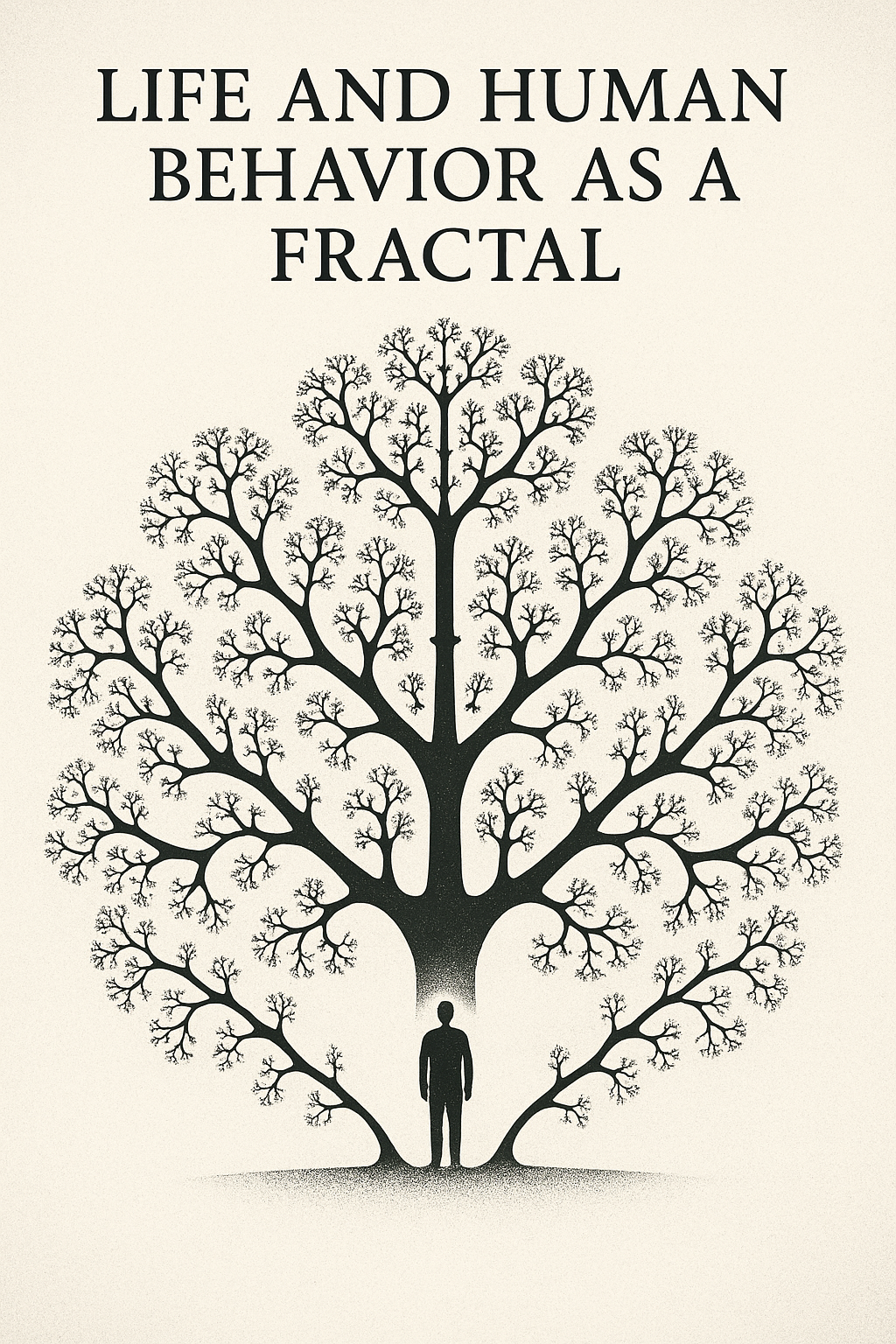
A metaphor: Imagine your life as a tree with fractal branches. You can't change the fact that it branches—that's how life grows—but you can choose which direction the next branch grows toward. Awareness turns repetition into evolution.
Life and human behaviour are fractal because the same underlying patterns of creation, conflict, adaptation, and renewal repeat at every scale—from a thought to a civilization, from a heartbeat to the cosmos.
The fractal nature of existence isn't a constraint—it's an invitation. Each repetition is a chance to see the pattern more clearly, to choose a different branch, to evolve the geometry of your consciousness. In recognizing the fractal, you gain the power to reshape it.